Bracing vs Taping vs “Just Strengthen It”: What Actually Helps an Unstable Ankle?
Author: Bennette Paul D. Campano, PTRP, CPT-CES
When an ankle feels unstable, most people want a simple answer: should I brace it, tape it, or just strengthen it and stop relying on support?
The honest answer is: it depends on what you’re doing, what phase you’re in, and what the ankle is currently capable of. Support tools can be useful, but they’re not a long-term substitute for restoring motion, strength, and reactive control.
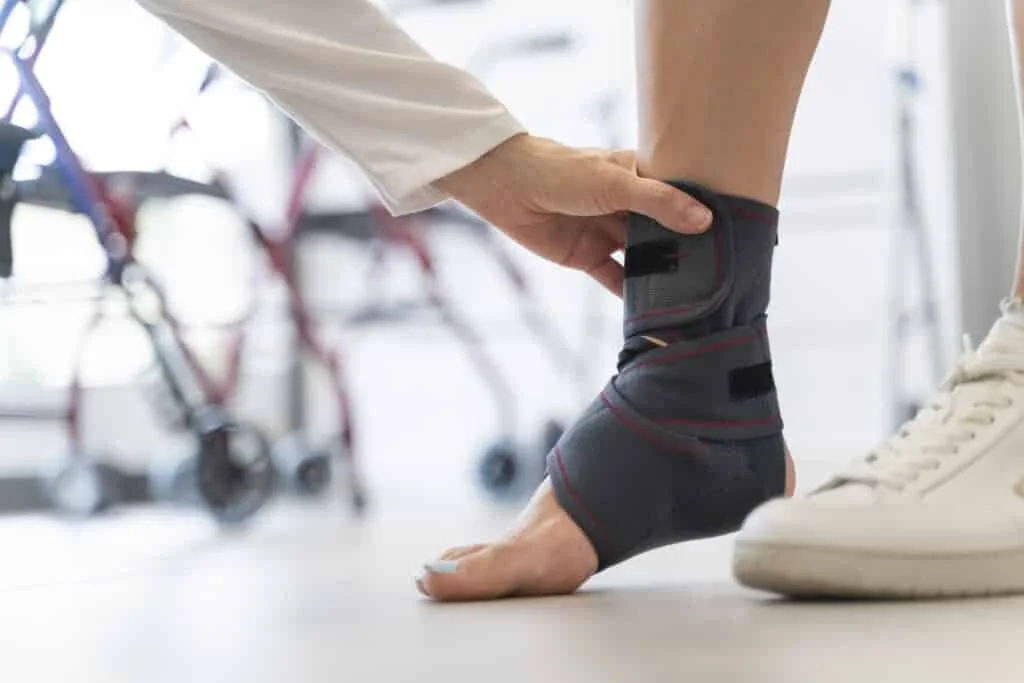
An ankle brace being fitted to provide external support, improve joint stability, and assist with recovery following injury or instability. Commonly used during rehabilitation, mobility training, and return-to-activity programs to help protect the ankle and reduce risk of reinjury.
What Bracing and Taping Are Good For
Bracing and taping can help in two main ways. First, they can reduce the risk of a sudden “roll” during higher-risk activities (court sports, trail running, field sports, jumping/landing work). Second, they can provide a sense of confidence, which matters because fear of re-injury changes how you move.
For people with chronic ankle instability, that confidence piece is not trivial. If you’re constantly guarding, you often land stiffer, avoid loading the ankle, and shift stress into the knee or hip.
The Downside Of Relying On Support Forever
If you brace or tape without rebuilding the system underneath, you can end up stuck in a loop. You feel safer with support, so you use it more. Because you use it more, you don’t challenge the ankle to regain full capacity. Because the ankle never regains full capacity, you feel unsafe without support.
That doesn’t mean bracing is “bad.” It means it should usually be paired with a plan.
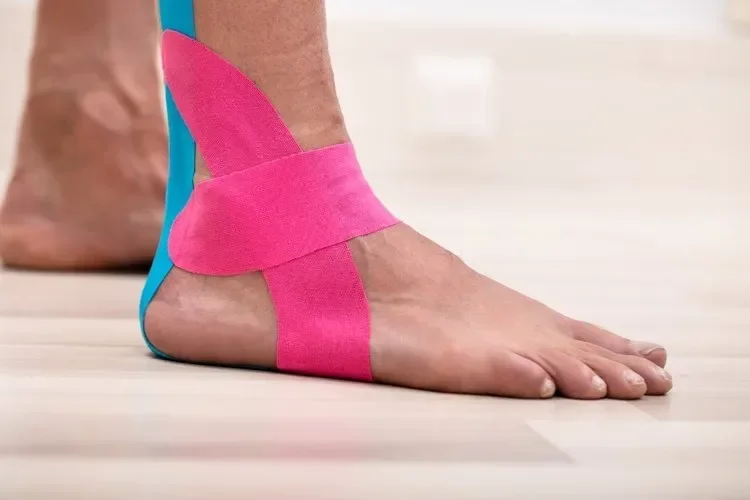
K-taping
Kinesiology taping applied to the ankle and foot to provide support, improve stability, and help reduce strain during movement and activity. Commonly used in rehabilitation and sports settings to assist with pain management, proprioception, and functional mobility.
When “Just Strengthen It” is The Right Idea (And When It Isn’t)
Strength is a huge part of stability, but “strength” has layers. You need calf strength and endurance for repeated impacts. You need peroneal strength to resist rolling. You need intrinsic foot strength to control the arch under load. And you need hip strength because the ankle doesn’t exist in isolation.
But if the ankle is still reactive, swollen, or stiff (especially limited dorsiflexion), jumping straight into aggressive strengthening can flare symptoms.
A Practical Approach
A good rule of thumb is to use bracing or taping as a short-term tool for higher-risk sessions while you rebuild the underlying capacity. Over time, the goal is to rely less on external support because your ankle is genuinely more stable.
Key Takeaways
Bracing and taping can reduce re-sprain risk during higher-risk activities and improve confidence, but long-term reliance without rehab can keep you stuck in a “needs support” loop. True stability is usually built through calf, peroneal, intrinsic foot, and hip strength, plus restoring motion if the ankle is stiff or reactive.
If you’re unsure whether support is helping you progress or keeping you stuck, a Physiotherapy Assessment could help you decide what to use (brace/tape/shoe changes), what to train, and what phase you’re actually in. Cristini Athletics Therapy is a good place to start because you’ll get 1:1 guidance, practical progressions, and training modifications that keep you moving forward.
About the Author
Benno is a physiotherapist registered in the Philippines (PTRP) and is now working in Canada as a trainer and Corrective Exercise Specialist (ISSA). He specializes in bridging people from post-operation rehab to return to play and optimizing performance, helping people go from post-op or persistent pain back to confident training, work, and sport. He’s passionate about helping clients move better, recover smarter, and reach their goals with a plan that’s practical, progressive, and individualized.